


From Care to Carer: Tom’s Journey into Step Across Fostering
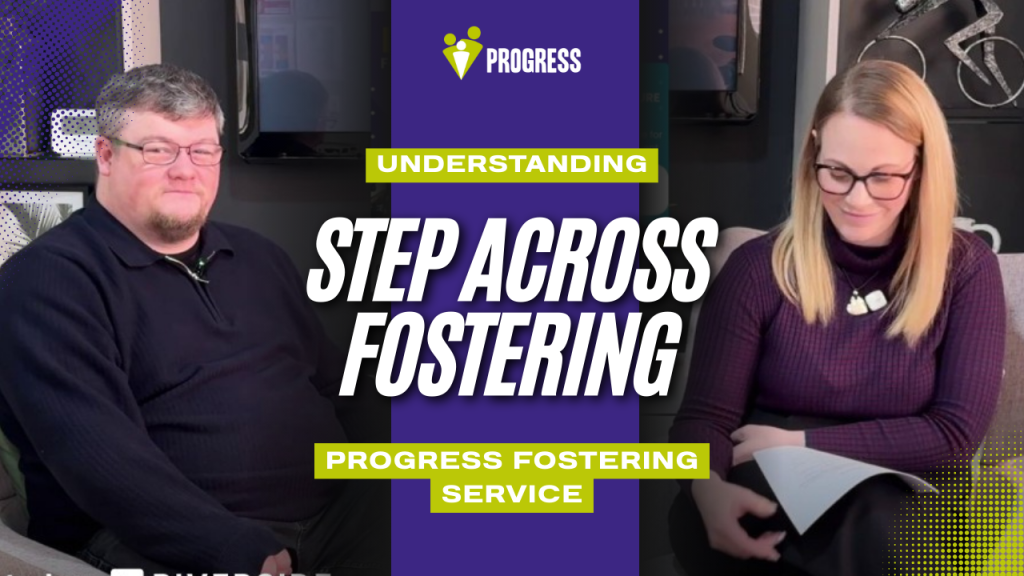
On a Wednesday afternoon, Progress Fostering Live returned for its fourth edition with a conversation that was never meant to feel like a presentation. Hosted by Kirsty, Relationship Manager at Progress, the session invited viewers into an honest, open discussion about fostering, lived experience, and what it really takes to support young people with complex needs.
At the heart of the conversation was Tom — a Step Across foster carer with nearly four years of fostering experience and more than a decade working across Progress’ residential services. What made this session resonate was not just Tom’s professional background, but his personal story. Tom grew up in care himself. Today, he is a foster dad supporting a young person.
This was not a polished success story. It was a lived one.
Growing up in care
When Tom speaks about his childhood, he does so plainly. Like many care-experienced people, he describes it as unstable and emotionally difficult. Going into care was not a decision imposed without thought. His mum made the choice voluntarily, through the courts, believing it was the best way for him to receive the support he needed.
At the time, Tom struggled to see it that way. “I was angry,” he says. “Angry at the system.” That anger sometimes spilled over onto residential staff and carers. Looking back now, Tom recognises that what he felt was not rejection of the people around him, but frustration at circumstances he did not yet understand.
With time and distance, his perspective changed. “That decision allowed me to come back on the right path,” he reflects. “It gave me the support I needed.” That understanding now underpins how he approaches fostering. When behaviour is challenging, when emotions come out sideways, Tom doesn’t take it personally. He recognises it as communication.
“I know it’s not about me,” he says. “It’s about something they’re struggling to explain.”
Finding his way into care work
Fostering was not Tom’s first role in the care sector. After leaving care, he tried various jobs, including work in banking and administration. None of them felt fulfilling. Everything shifted when he began volunteering with The Children’s Society and SOVA, now Change Grow Live. In 2016, he received an award at Lambeth Palace for his voluntary work. That moment gave him clarity.
“I realised I needed to work in care,” he says. “I wanted to enjoy what I was doing. I wanted to make a difference.”
He started in a respite home, then joined Progress, working across residential services including Regis House and Oak Cottage. Over the years, he built experience, became a Deputy Manager, and developed a deep understanding of children’s needs in residential settings. Fostering, he says, felt like the natural next step.
What appealed to Tom most about fostering was the shift away from rotas and shifts. “My life wasn’t determined by a rota anymore,” he explains. “I wasn’t worrying about whether staff would turn up. I was the staff member.”
But more importantly, he was something else entirely. “I wasn’t just staff,” he says. “I was his foster dad.” Fostering stopped feeling like work. It became a way of life. A home. A relationship.
Understanding Step Across fostering
During the live session, Tom was asked to explain Step Across fostering in simple terms. He didn’t reach for definitions. He spoke about people.
His young person had been living in residential care, supported by structure, staffing and constant supervision. While residential care met many needs, it wasn’t where he needed to stay long term.
Through careful planning and assessment, it was agreed that a move into foster care would offer greater emotional stability and a more relaxed environment. “Step Across is that chance,” Tom says. “A chance at real family life before adulthood hits at 18.”
For older children, that opportunity is often harder to come by. Step Across creates space for transition rather than sudden change, allowing young people to move at their own pace.

Building trust before moving in
One of the defining features of Step Across fostering is the opportunity to build a relationship before a child moves in. For Tom and his young person, that process was central.
Their first meeting was informal. They played video games together in the care home. They talked about shared interests, including gaming and football. There was no pressure. “He needed time,” Tom explains. “And that was okay.”
It took a month before the young person chose to meet again. That choice mattered. Step Across allows young people to say no at any stage. “This is their home,” Tom says. “They have to feel comfortable too.” Visits gradually increased. Short visits. Day visits. Overnight stays. When the move eventually happened, it didn’t feel like a leap into the unknown.
“That’s why Step Across works,” Tom reflects. “It’s built on consent and trust.”
Settling into family life
Confidence didn’t arrive overnight. Tom describes the early months as a period of learning and adjustment for both of them. It was around six months in that things truly settled. “We knew each other’s routines,” he says. “What worked, what didn’t.”
Challenges remained, but they no longer felt destabilising. Having previously fostered in a respite capacity, Tom noticed how long-term fostering allowed deeper connections to form. “I enjoy it,” he says. “I know I’ve made the right decision.”
Support behind the scenes
Throughout the session, Tom was clear about one thing: he is not doing this alone.
As a Step Across foster carer supporting a young person with complex needs, he receives ongoing therapeutic input, regular supervision, respite, and training. He works closely with a therapist to reflect on behaviour, communication and strategies. “It helps you check you’re doing the right things,” he says. “And it helps take the pressure off.”
Support is flexible and responsive. Even when sessions can’t take place, help is only an email or phone call away. “That reassurance matters,” Tom adds.
Who Step Across is really for
When asked who Step Across fostering is suited to, Tom doesn’t limit his answer to professionals or people with experience. “Anyone can do it,” he says. Even with years in residential care, he had doubts. What matters most, he believes, is openness, patience and willingness to learn.
“We all know how to care,” he says. “This is about extending that care.” At a time when the need for Step Across foster carers is growing, Tom sees the model as vital.
Fear is one of the most common emotions for people considering fostering. Tom doesn’t dismiss it.
“You have every right to feel scared,” he says. What makes the difference is support — from supervising social workers, therapists and other carers. Relationships that feel human, not hierarchical.
Attachment, he believes, is unavoidable. And necessary. Many of the young people Tom supported through respite remain in touch. Some visit. Some message. Some return years later to say thank you. “You don’t really lose them,” he reflects. “They come back when they’re ready.”
His door, he says, will always be open.
Why it’s worth it
On the hardest days, Tom’s motivation is simple. “I’m there for him,” he says. “He deserves a second chance.” He speaks about pride in educational progress, about supporting independence, about seeing a young person begin to imagine a future.
Step Across fostering, for Tom, offers something residential care often cannot: a gentler transition into adulthood. “That step into the real world doesn’t have to be sudden,” he says. “It can be gradual.”
At its heart, this is what the live session revealed. Step Across fostering is not about rescuing or fixing. It is about consistency, patience and showing up, day after day. For Tom, it is about being the person he once needed — and offering a sense of home that lasts well beyond placement endings.